Stainless steel bars are solid metal sections that mills roll, forge, draw, or machine into round, flat, square, and hexagonal profiles. Each bar carries a defined grade, size, finish, and supply condition, and those choices decide where it performs. Corrosion resistance, strength, machinability and temperature performance place them in pump shafts, fasteners, valve stems and food processing equipment. Grades differ sharply: 304 resists atmospheric corrosion, 316L tolerates chlorides, 410 hardens for wear parts, and 310 withstands furnace heat. This guide covers the definition, specifications, properties, grades, types, applications, advantages and limitations, grade and type comparison, and selection criteria for buyers and engineers.
What are Stainless Steel Bars?
Stainless steel bars are solid, elongated products that carry a uniform cross section, such as round, flat, square, or hexagonal. Producers make each bar from a specified grade, and that grade sets the chemical, mechanical, and service characteristics the bar delivers.
Round, flat, square, hexagonal, bright, and forged bars cover the common forms. Machine shops turn, mill and thread them, and fabricators weld them into frames and supports. Shafts, fasteners, spindles and other engineered parts all start as bar stock.
Specifications of Stainless Steel Bars
Nine fields identify a bar in an enquiry, quotation, or purchase order. Buyers and suppliers confirm each one before production or dispatch.
| Specification | What to Cover |
| Grade | 304, 316L, 410, 430, 17 4 PH, 904L, SMO 254 and others |
| Shape / Type | Round, flat, square, hexagonal, bright, forged, special forms |
| Diameter / Size | Diameter for round bars; width and thickness for flat bars |
| Length | Standard mill length or cut to length |
| Surface Finish | Bright, polished, ground, annealed, pickled, machined |
| Manufacturing Condition | Hot finished, cold finished, annealed, heat treated, hardened and tempered |
| Tolerance | Dimensional and straightness limits |
| Standards | ASTM, ASME, EN, DIN or project requirements |
| Testing / Certification | Chemical analysis, mechanical tests, heat treatment records, MTC, traceability |
Common Standards for Stainless Steel Bars
ASTM A276/A276M covers hot finished and cold finished bars, plus hot rolled or extruded shapes, in the grades it lists. ASTM A479/A479M applies where bars serve in boilers, pressure vessels, and other heat service equipment. Projects that follow European material standards cite EN 10088 Part 3 or DIN equivalents. Grade, product form, dimensions, application, and project requirements determine the applicable standard, since no single standard covers every grade or form.
Properties of Stainless Steel Bars
Property values shift with grade and supply condition. Annealed 304 and 316 bars carry minimum values of 515 MPa tensile and 205 MPa yield strength under ASTM A276, while 17- 4 PH reaches 1,310 MPa tensile in the H900 condition. Density spans 7.7 to 8.0 g/cm³ across the families, and austenitic grades conduct heat at approximately one third the rate of carbon steel. Three property groups below separate one grade from another and determine service fit.
Chemical Properties
| Element | Importance |
| Chromium | Forms the passive oxide layer behind corrosion and oxidation resistance |
| Nickel | Supports the austenitic structure, toughness, and corrosion resistance |
| Molybdenum | Improves resistance to localized corrosion in grades such as 316L and 904L |
| Carbon | Influences strength, carbide formation, weldability and heat behavior |
| Nitrogen | Raises strength and austenite stability in selected grades |
| Titanium / Niobium | Stabilize grades 321 and 347 |
| Other Alloying Elements | Influence heat resistance, hardenability and machinability |
Mechanical Properties
| Property | What It Indicates |
| Tensile Strength | Maximum stress before failure |
| Yield Strength | Stress where permanent deformation begins |
| Elongation | Ductility and deformation capacity |
| Hardness | Resistance to indentation and wear |
| Toughness | Energy absorbed before fracture |
| Fatigue Strength | Resistance to cyclic loading |
Physical Properties
| Property | Relevance |
| Density | Component weight calculations |
| Thermal Conductivity | Heat transfer behavior |
| Thermal Expansion | Movement under temperature change |
| Electrical Resistivity | Electrical and heating uses |
| Magnetic Response | Differs among austenitic, ferritic, martensitic and duplex families |
| Melting Range | High temperature processing limits |
Stainless Steel Bar Grades
Grade fixes chemistry and chemistry fixes performance. Five families cover the main grades supplied.
Austenitic grades carry nickel, stay non-magnetic when annealed, and weld readily. Grade 304 serves general fabrication, while 304L lowers carbon to protect welds from carbide precipitation. Grades 316 and 316L add molybdenum, which lifts chloride resistance and separates them from 304 in marine and chemical service. Grade 303 trades corrosion resistance for free machining through added sulphur.
Ferritic grade 430 doesn’t carry nickel addition, resists mild corrosion and nitric acid, and stays magnetic. The missing nickel keeps its price below 304.
Heat treatment defines the martensitic grades. Grade 410 combines moderate corrosion resistance with hardenable strength, 416 machines freely, and 420 reaches higher hardness for cutting tools and wear parts. Suppliers ship them annealed for machining or hardened and tempered for service.
Aging treatment between 480°C and 620°C gives 17- 4 PH its strength, while corrosion resistance stays close to 304.
Severe service requires specialty and heat-resistant grades. Grade 310 handles continuous exposure near 1,100°C. Titanium in 321 and niobium in 347 keep welded parts stable in the sensitizing temperature range. Duplex 2205 more than doubles the yield strength of 304, and 904L with SMO 254 withstands sulphuric acid, chloride, and seawater exposure.
| Grade | Family | Common Uses |
| 304 / 304L | Austenitic | Food equipment, general fabrication, architectural trim |
| 316 / 316L | Austenitic | Marine fittings, chemical equipment, pharmaceutical parts |
| 303 | Austenitic | Turned fasteners, bushings, fittings |
| 430 | Ferritic | Appliance trim, nitric acid equipment |
| 410 | Martensitic | Valve trim, pump shafts, hardened fasteners |
| 416 | Martensitic | Free machining shafts, studs, gears |
| 420 | Martensitic | Cutlery, surgical instruments, wear parts |
| 17 4 PH | Precipitation hardening | Aerospace fittings, high strength shafts, valve parts |
| 310 | Heat resistant | Furnace parts, kiln fixtures, burner components |
| 321 / 347 | Heat resistant | Exhaust components, heat exchanger parts |
| 2205 | Duplex | Subsea shafts, chemical process parts |
| 904L / SMO 254 | Super austenitic | Acid, seawater and desalination equipment |
Types of Stainless Steel Bars
Type identifies the physical form, independent of grade.
Round Bar
Round bars have a circular section specified by diameter. They become shafts, spindles, pins, studs and turned components. Hot rolled, cold drawn, and ground supply conditions exist.
Flat Bar
Flat bars have a rectangular section specified by width and thickness. Fabricators cut them into brackets, straps, base plates and frames.
Square Bar
Four equal sides let square bars resist rotation in keyed and locked assemblies. Railings, tool posts and machine components use them.
Hex Bar
Hex bars have six flat sides measured across flats. Manufacturers machine them into nuts, bolts, fittings, and other parts that take a wrench. Cold drawn hex bars hold close tolerances across flats.
Bright Bar
Bright bars undergo cold drawing, turning, grinding, or polishing, which delivers a smooth surface and tight diameter tolerance. Precision shafts and instrumentation parts use them.
Forged Bar
Forged bars come from hot forging, which refines grain structure and produces large diameters. Heavy shafts, discs, and pressure components start here.
Special Shapes
Special shapes include angle, channel, tee and custom profile sections. Mills roll or extrude them where a standard bar wastes material or machining time.
Applications of Stainless Steel Bars
Stainless steel bars serve sectors that need corrosion resistance and strength in a solid section, and each sector pairs particular grades with particular forms.
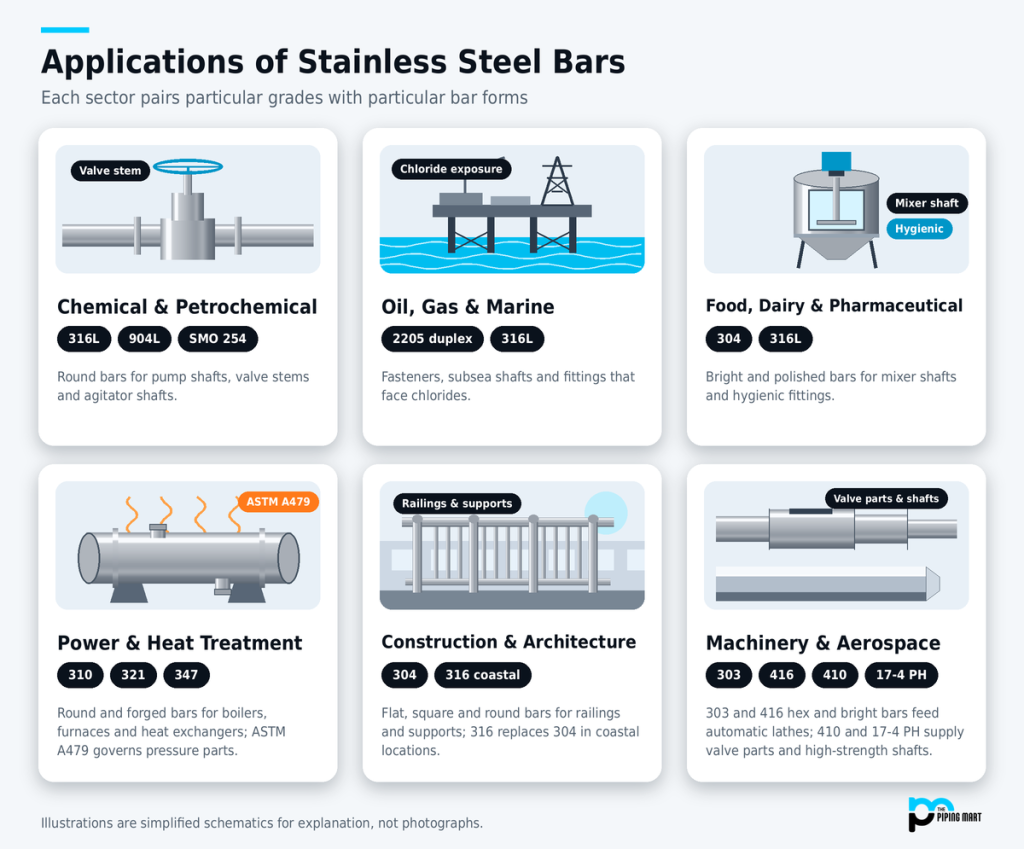
- Chemical and petrochemical: 316L, 904L and SMO 254 round bars form pump shafts, valve stems and agitator shafts.
- Oil, gas and marine: 2205 duplex and 316L bars make fasteners, subsea shafts and fittings that face chlorides.
- Food, dairy and pharmaceutical: Bright and polished 304 and 316L bars make mixer shafts and hygienic fittings.
- Power and heat treatment: Round and forged bars in 310, 321 and 347 serve boilers, furnaces and heat exchangers, with ASTM A479 governing pressure parts.
- Construction and architecture: 304 flat, square and round bars form railings and supports, and 316 replaces 304 in coastal locations.
- Machinery and aerospace: 303 and 416 hex and bright bars feed automatic lathes, while 410 and 17- 4 PH supply valve parts and high-strength shafts.
No grade suits every application. Temperature, corrosion exposure, mechanical loading, fabrication route, and applicable specifications decide the match. A mismatched grade shortens service life through pitting, stress corrosion cracking, or scaling.
Advantages and Limitations of Stainless Steel Bars
Advantages
- Corrosion resistance: The chromium oxide layer repairs itself wherever oxygen is present.
- Strength and durability: Martensitic and precipitation hardening grades add hardness and wear resistance.
- Hygiene and cleanability: Smooth, non-porous surfaces clean readily and resist contamination.
- Temperature resistance: Selected grades hold up from cryogenic conditions to furnace heat.
- Recyclability: Scrap melts into new stainless steel without losing its properties.
Limitations
- High cost: Nickel, molybdenum and chromium push prices above carbon steel.
- Difficult machining and fabrication: Austenitic grades work harden quickly, wear tools and demand controlled welding heat.
- Poor thermal conductivity: Heat spreads slowly, which creates hot spots in tooling and heat exchange parts.
- Heavy weight: Density reaches nearly three times that of aluminium, which raises handling and transport loads.
- Challenging surface treatments: Passivation, pickling and electropolishing need controlled chemistry, and coatings bond poorly.
How to Choose the Right Stainless Steel Bar
A fixed sequence of eight checks prevents mismatched orders and rejected material.
- Define the application. State the component function and manufacturing process.
- Assess the environment. Check moisture, chemicals, chlorides, marine exposure, temperature and oxidation.
- Select the grade. Match corrosion resistance, strength, hardness, machinability, weldability and temperature limits.
- Select the bar type. Choose round, flat, square, hexagonal or another required form.
- Specify dimensions. Confirm diameter, width, thickness, length and tolerances.
- Confirm finish and condition. Name bright, polished, ground, annealed, heat treated or another condition.
- Verify standards. Check ASTM, ASME, EN, DIN or project specifications.
- Confirm certification. Review chemical composition, mechanical test results, MTC and traceability.
Procurement should confirm grade, form, dimensions, condition and applicable standard together, since a mismatch in any one of them invalidates the order.
Conclusion
Stainless steel bars combine corrosion resistance, strength, and machinability in solid sections that serve shafts, fasteners, valve parts, and structural members. Grade sets the material characteristics, while type names the physical form of the bar, so the two decisions stay separate on every purchase order. This guide covered austenitic, ferritic, martensitic, precipitation hardening, and specialty heat-resistant families. Selection depends on corrosion exposure, temperature, strength, machining, fabrication, dimensions, and the applicable standard, and confirming all of them before procurement protects service life and inspection outcomes.
FAQs About Stainless Steel Bars
What are stainless steel bars?
Solid stainless steel sections in round, flat, square, or hexagonal form, which shops machine into shafts, fasteners, and structural parts.
What are the different types of stainless steel bars?
Round, flat, square, hex, bright and forged bars, plus special shapes such as angles, channels and tees.
What are the main grades of stainless steel bars?
Austenitic 304, 316L and 303, ferritic 430, martensitic 410 and 420, precipitation hardening 17- 4 PH, and specialty 310, 2205, 904L and SMO 254.
What is the difference between 304 and 316 stainless steel bars?
Molybdenum in 316 gives stronger resistance to chlorides and pitting. Grade 304 costs less and suits indoor, food, and general service.
Which stainless steel bar grades are suitable for high-temperature applications?
Grade 310 handles continuous service near 1,100°C, and 321, 347, and 304H cover elevated temperature work in welded parts.
Which stainless steel bars are suitable for machining?
Grades 303 and 416 machine freely because of added sulphur. Annealed 304 and 316 need slower speeds and sharp tooling.
What is the difference between a stainless steel grade and bar type?
Grade defines chemistry and performance, while type defines the cross section. A 316L round bar and a 316L hex bar share material but not form.
What standards are commonly used for stainless steel bars?
ASTM A276/A276M, ASTM A479/A479M, and EN 10088 Part 3 lead the list.
How do I select the right stainless steel bar grade?
Begin with the corrosion environment and operating temperature, then test strength, machinability, and weldability against the standard’s property tables.
Are stainless steel bars available in different finishes and conditions?
Yes. Bright, polished, ground, annealed, pickled, and machined finishes exist in hot-finished, cold-finished, annealed, or heat-treated conditions.