Monel 400 is widely used by marine and plant engineers for pump shafts, seawater piping, and HF acid handling equipment due to its strength and high corrosion resistance. Understanding its chemical composition explains why it performs so well in harsh environments. This alloy, which is primarily composed of nickel and copper with trace amounts of iron, manganese, carbon, and silicon, is extremely resistant to seawater, acids, and alkalis, where many other materials fail. This guide provides a clear and practical overview of Monel 400, including its chemical composition, key mechanical properties, hardness, density, and applications in various industries. It allows engineers and buyers to evaluate its suitability without excessive detail.
What Is Monel Alloy 400?
Monel 400 is a high-performance nickel-copper alloy that plays a key role in materials science, especially where extreme corrosion resistance and mechanical durability are required. This alloy was produced in the early twentieth century, is distinguished by its solid-solution structure, which provides a unique combination of strength and ductility across a wide temperature range. Its chemical composition, which primarily consists of 63-70% nickel and 28-34% copper, allows it to retain structural integrity in environments that would quickly degrade standard stainless steels or carbon steels.
Monel 400 Chemical Composition Breakdown
The composition is tightly controlled to ensure consistent corrosion performance and mechanical behaviour. Here is the standard breakdown:
| Element | Content |
| Nickel (Ni) | 63% min |
| Copper (Cu) | 28–34% |
| Iron (Fe) | 2.5% max |
| Manganese (Mn) | 2.0% max |
| Carbon (C) | 0.3% max |
| Silicon (Si) | 0.5% max |
| Sulfur (S) | 0.024% max |
The Monel 400 chemical composition is straightforward; nickel and copper make up the bulk of it, and everything else is a controlled trace element.
Why Nickel-Copper Dominates the Mix
The high nickel content (at least 63%) ensures toughness and corrosion resistance over a wide pH range. Copper is added to enhance the alloy’s performance in reducing environments such as sulphuric acid and seawater. This specific ratio results in a material that is stable across a wide temperature range.
Trace Elements and Their Roles
Iron is kept below 2.5% to protect corrosion resistance, while manganese supports deoxidation and ductility. Carbon is kept below 0.3% (per ASTM B127) to reduce carbide formation during welding and maintain corrosion resistance. Silicon and sulphur levels are also kept under control to ensure a good surface finish and weldability, resulting in consistent performance across batches.
Monel 400 Mechanical Properties Explained
Monel 400’s mechanical properties differ based on whether it is annealed or cold-worked. Both conditions are used, but they serve different purposes.
| Property | Annealed | Cold-Worked |
| Tensile Strength | 70,000–80,000 psi | Up to 100,000 psi+ |
| Yield Strength | 25,000–35,000 psi | 40,000–50,000 psi |
| Elongation | 35–50% | 15–25% |
| Modulus of Elasticity | 26 × 10⁶ psi | 26 × 10⁶ psi |
Tensile and Yield Strength
In the annealed condition, tensile strength sits around 70,000–80,000 psi with a yield around 25,000–35,000 psi. Cold working increases yield strength considerably, useful where higher pressure ratings or load-bearing performance is needed. Pump shafts and valve stems are often specified in a cold-worked condition for this reason.
Elongation and Ductility
The high elongation (35–50% in annealed condition) means the alloy can be formed without cracking. It can be cold-formed, hot-formed between 1700–2100°F, and machined. The flexibility is useful in fabrication, particularly for complex fittings or flanged components.
Density and Physical Characteristics
| Property | Value |
| Density | 8.80 g/cm³ (0.318 lb/in³) |
| Melting Range | 1300–1350°C (2370–2460°F) |
| Thermal Conductivity | 21.8 W/m·K |
| Electrical Resistivity | 0.547 µΩ·m |
| Thermal Expansion | 13.9 µm/m·°C |
Monel 400 density at 8.80 g/cm³ is higher than carbon steel (7.85 g/cm³) and similar to stainless steel (around 8.0 g/cm³). Designers working on weight-sensitive structures should account for this. The melting range is fairly wide, which helps in high-heat applications like steam generators.
Where Monel 400 Performs Best
The alloy handles a working temperature range from cryogenic conditions down to -300°F up to around 1000°F in oxidising environments. Below are the main areas where it’s regularly specified.
- Marine and Saltwater Environments
Monel 400 has very low corrosion rates in seawater, typically under 1 mil/year and resists biofouling and cavitation damage. Offshore platforms use it for pump shafts, propeller shafts, fasteners, and seawater piping. It also resists stress corrosion cracking in chloride environments, which is a known weakness of austenitic stainless steels.
- Chemical Processing Industries
The alloy is one of the few materials that holds up in hydrofluoric acid service, both concentrated and dilute. It’s also used in equipment handling alkalis, neutral salt solutions, and some organic acids. In situations where 316 stainless would corrode too quickly, Monel 400 is the standard alternative for equipment like HF alkylation units, pickling tanks, and reaction vessels.
- Oil and Gas Applications
Used in sour gas service, crude distillation, and downhole tooling. Valve trim, wellhead components, and tubing in environments with hydrogen sulphide are common applications. It handles crude oil stills and process equipment in refineries where sulphur compounds are present.
Monel 400 Products
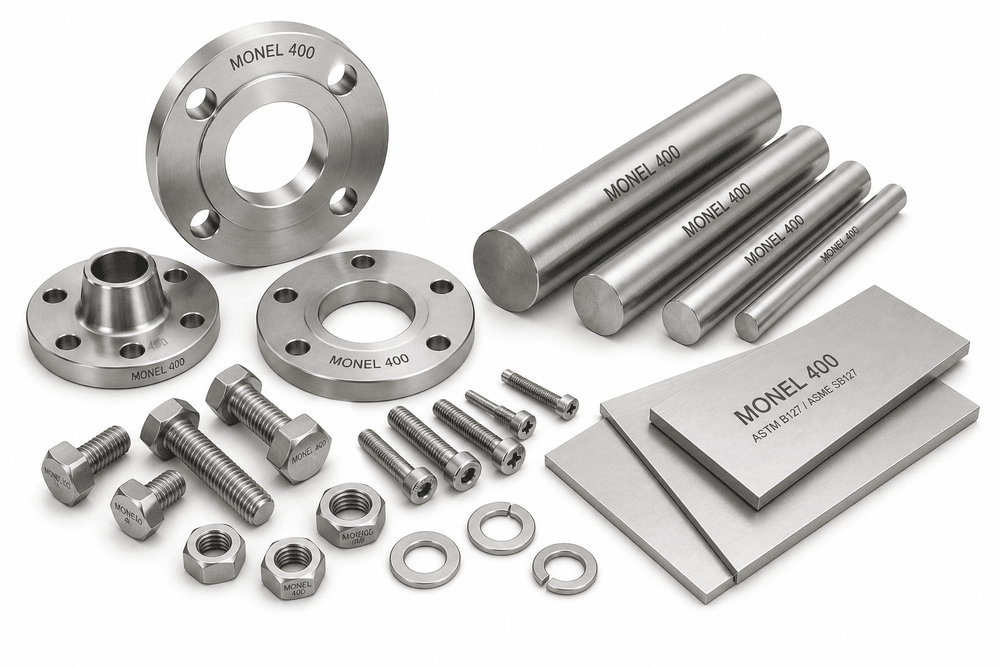
Monel 400 is available in a broad range of product forms, covering everything from structural sections to precision fasteners. Below is a list of standard products manufactured in Monel 400, along with their typical use.
- Monel 400 pipes: It is used to transport corrosive chemicals and seawater in industrial piping systems.
- Monel 400 Plates: The thick flat sections used to build large tanks, pressure vessels, and heat exchanger shells.
- Monel 400 valves: It is critical for controlling flow in acidic or high-salt environments without seizing.
- Monel 400 Instrumentation Fittings: Small connectors used in precision sensors and control systems.
- Monel 400 Bolts & Nuts: Heavy-duty fasteners that won’t rust or snap in marine or chemical settings.
- Monel 400 Stud Bolts & Washers: Used to secure flanges in high-pressure piping assemblies.
- Monel 400 Channels and Angles: Structural shapes are used to create supports in corrosive environments.
- Monel 400 Screws: Smaller fasteners used in equipment assembly where corrosion resistance is required.
- Monel 400 tubing: It is commonly used in heat exchangers and condenser systems for power plants.
- Monel 400 Pipe Fittings: Elbows and tees are used to connect and redirect pipe runs.
- Monel 400 Coil and Wire: It is used to make springs, mesh filters, and heating elements.
- Monel 400 Circles: Round plate cutouts for end caps or specialised machined components.
- Monel 400 Forged Fittings: Forging produces high-strength components that are ideal for high-pressure applications.
- Monel 400 Flanges: These connect sections of pipe or connect pipes to valves and pumps.
- Monel 400 bars: Solid rounds or hexes used for machining shafts and other hardware.
- Monel 400 Fasteners: A general category for all the hardware holding corrosive systems together.
- Monel 400 Electrodes: Welding rods specifically designed to join Monel 400 to itself or other metals.
- Monel 400 Gaskets: Used to create a tight seal between flanges in aggressive fluid systems.
Conclusion
Monel 400 holds its position in material selection because the nickel-copper composition genuinely delivers in environments where common alternatives don’t. The mechanical properties are consistent and well-documented, the density and thermal data are stable, and the performance record in marine, chemical, and oil and gas service is long-established. If you’re specifying Monel 400 for a critical application, work from current ASTM standards (B127, B164, B165) and source from certified suppliers who provide material test reports. Consult material specifications for your exact application before finalising grade selection.
FAQ
Can Monel 400 be welded easily?
Yes, it welds well using GTAW, GMAW, or SMAW methods with compatible Monel filler wire. Preheating isn’t normally required, but the interpass temperature should be controlled and overheating avoided to prevent hot cracking at the heat-affected zone.
What’s the difference between Monel 400 and 316 stainless steel?
Monel 400 offers superior resistance to seawater and hydrofluoric acid because of its nickel-copper base, while 316 stainless relies on chromium and molybdenum for corrosion protection. 316 stainless is more cost-effective for general-purpose corrosion resistance and performs better in high-temperature oxidising conditions.
Does Monel 400 corrode in seawater?
Corrosion in seawater is very slow, usually less than 1 mil per year under normal flow conditions. It also resists biofouling and cavitation erosion better than most copper alloys and stainless grades, making it well-suited for submerged marine components.
Is Monel 400 magnetic?
In the annealed state, it is basically non-magnetic. Cold working can make it slightly magnetic because the structure changes, but this effect is usually so small that engineers still treat it as non-magnetic.
How hard is Monel 400 to machine?
It work-hardens quickly, which makes it harder to machine than carbon steel and comparable in difficulty to austenitic stainless. Carbide tooling, sharp cutting edges, consistent feeds and speeds and adequate cutting fluid are all necessary for acceptable tool life and surface finish.
What temperature range can Monel 400 handle?
It performs reliably from cryogenic temperatures down to around -300°F through to approximately 1000°F in oxidising service. Mechanical properties remain relatively stable across most of this range, though high-temperature strength will reduce above 800°F.